A Bench Near the Door
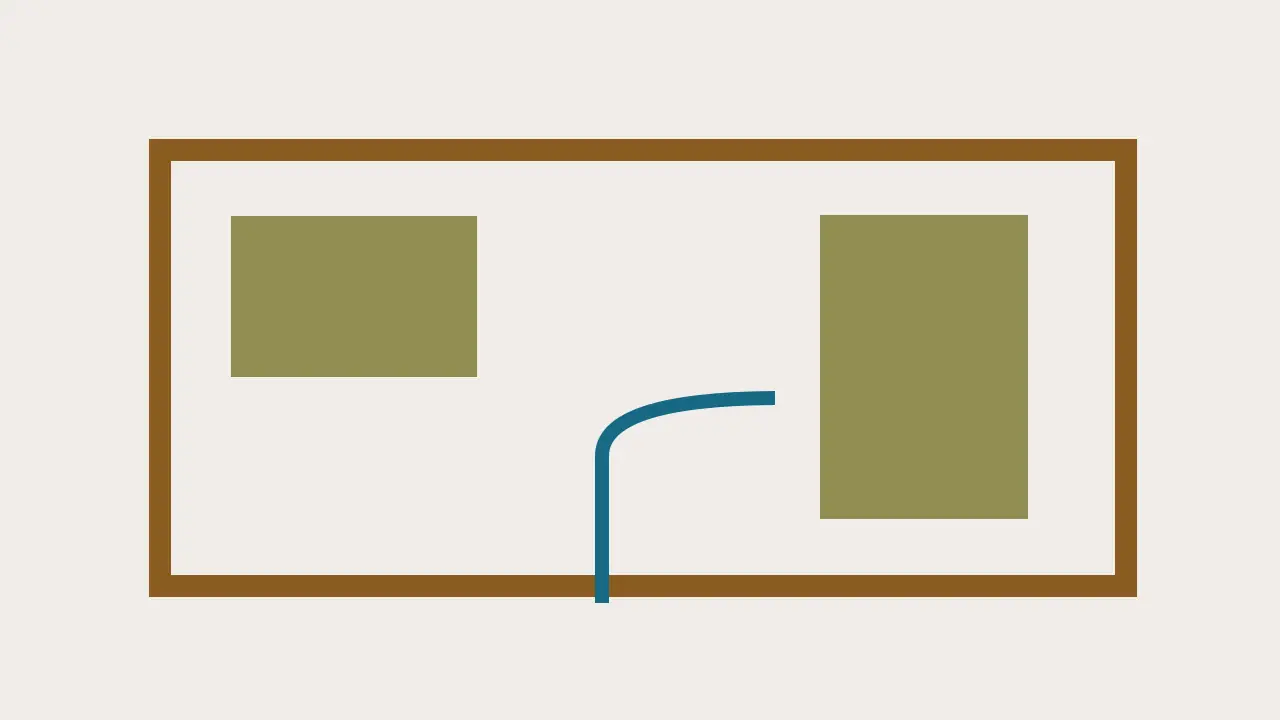
The first barn arrangement put a deep bench straight inside the door. It collected the opening load from the field and gave the room an obvious purpose. A second person carrying a wide basket then had to turn around a housepost to reach the drying rack. We kept a place to set something down by the entrance and changed how much of the bench belonged there.
Test an ordinary wet arrival
The farmer starts outside the gate with a small crate. The shortest route goes through the main door, turns toward a side wall and reaches a board just under cover. A narrow surface here can be useful within seconds of opening the barn. While the farmer sets the crate down, the door can still be pushed closed and another person can see where it will move.
On the first layout the board was deep enough to hold two rows of baskets. That made unloading easier for one round. By the next round a basket had moved closer to the aisle, and the route beside the housepost was no longer broad enough. We inspect the doorway with the board empty and again after a common load is put down. A free route should survive ordinary use long enough for the next person to see it.
Find the difference between a stop and a station
The shorter board can catch a first load safely. It isn’t a suitable place to sort a full harvest. The next version puts a second table deeper inside in a light area near the rack. A person working there can separate the baskets without making repeated turns beside the door. The board in the entrance keeps its brief purpose and does not need to store all the tools somebody would use later.
We draw these surfaces at different heights. The deep table stands just below an exposed window beam and leaves its open side facing a clear corner. The door shelf has a shallow face and a visible edge to help the farmer set things down. That shape can remain in the same place even when the heavier table is moved to suit a new task.
Check the path with a visitor already present
Another neighbor can be working at the inner table when a load arrives. Our first exercise always started with the room empty. A tidy arrangement could look correct until both positions were occupied. The current version makes the narrow turn part of an ordinary arrival. Stop once near the door and let the player see that they need room to pass as well as a place to put their own basket down.
If the passage gets blocked, the farmer can clear it without undoing the entire layout. There is a visible place to carry one basket to the side table. They can also change which table the neighbor is using while they move a heavy load. Both are small actions. The point is that a good arrangement should remain useful through several rounds of work, with enough clear ground to make an adjustment.
Record what the bench still does well
The Open Barn connects a first dry place to the next delivery from the field. Walk the Harvest Path follows the larger load once the drying rack is in use. The earlier bench is still useful because it lets the farmer break one trip into two. Our next review checks that this small stop remains there after we widen the passage. A room can improve through a less intrusive placement while preserving the reason somebody wanted a little surface near the entrance in the first place.